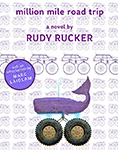
Click covers for info. Copyright (C) Rudy Rucker 2021.


Archive for the ‘Rudy’s Blog’ Category

Comparing Writing and Painting

Thursday, May 31st, 2012

Today I’m discussing some analogies between writing and the visual arts (drawing and painting). By way of background, here are links to a bunch of my drawings (for Saucer Wisdom) and to my paintings.

(i) When drawing, I get some quick sketch in pencil, then ink it in, then have to white out pieces and redraw them. Or if I’m painting, the same thing, I just rough it out in light paint and see if it’s the right shape. I don’t actually have the ability to draw a person so they look exactly right on the first go. When painting I pick away at it with my brushes and colors until it looks okay.

In writing I try and write a rough version of the section pretty quickly, then go over it and tune it, and then there will be things that don’t work that I have to keep redoing. But eventually I feel it’s right. Versimilitude is a process, not a one-shot thing. And (side-point) photo-realism isn’t the only goal.


[A likeable punk roadie for The Recently Deceased, seen at the Anarchist Book Fair in Golden Gate Park.]

(ii) In drawing, whenever there’s a part I’m confused about—something tricky like two hands holding each other—I end up having to use lots and lots of white-out. Or if I’m painting I rub off paint and layer new paint over. And it ends up all bumpy and crufty and never does look as smooth and clean as the rest of the picture.

In writing, the transitions or actions I’m not clear about take the most rewriting and reworking. But I don’t think it’s necessarily true that a rewritten patch has to be bumpy and crufty as does a redrawn patch; in drawing the bumpiness is partly a result simply of the not-so-great physical properties of the white-out, or in painting it has to do with whether or not I bother to sand off the bumpy impasto layers beneath. But maybe gnarly cruft is okay too.


[Street murals in Balmy Alley off 24th St. in SF.]

(iii) When drawing or painting, I sometimes think that if only I could take the time to fully visualize the difficult passage then I’d be able to draw it clean and right the first time. But often it just seems too hard to think, and I go ahead and draw it or paint it wrong, just so I have something to work off of.

In writing, I’ll often think that if only I could fully think through a scene I could write it much more effectively. But many times it’s just too hard to think all that—I’ll feel like being active, in touch with the medium, so I just go ahead and write even though I’m not sure what I’m doing. And then I take it from there.

(iv) In both mediums, I need to realize that something that might have the superficial appearance of a finished piece, but that it’s really still a sketch or a first layer that needs to be reworked. I’m kind of surprised how prolonged a process it is to make a drawing or what I consider to be a finished painting. I hadn’t realized it would take so much revision. By long experience, I’m of course familiar with the huge amount of revision that a written scene takes. It’s kind of comforting to see that visual art can be just as hard.


[Clouds’ Point of View , painting by Isabel Rucker.]

(v) My old art mentor Paul Mavrides says about art in general, “It’s not the realistic style that matters so much. It’s having something to say.” And this makes me feel free to write a little more cartoony and sketchy sometimes. Or to be more expressionistic in a painting. And in writing this idea helps me fight my feeling of being inferior to a fine literature exponent who creates beautifully textured descriptions and aperçus in a work that perhaps doesn’t have all that much to say.


[Copa Loca ice-cream parlor in the Mission.]

(vi) I worship the notion of “eyeball kicks,” as in the early cartoons by Will Elder in Mad and Panic. Elder’s eyeball kicks are, to me, of a piece with the piled-on detail of Bosch’s teeming works. A higher apotheosis is reached in the later Bruegel where there’s still very much action, but the surface doesn’t teem and wriggle, it’s harmonious and integrated. And this I try and fill up the surfaces of my canvases.

And Will Elder, Bosch and Bruegel have always been touchstone icons for the kinds of novels I want to write. Over the years I’ve felt like my writing has gotten closer to this ideal. It’s a matter of taking your time…without losing the thread.


[View of SF from McLaren Park, reminds me of the crystal city in the background of a Bosch painting of Saint Anthony (not the triptych one).]

(vii) One problem in painting or in writing is how to suggest the endless levels of Nature’s span and detail while only using a square meter of canvas or a hundred thousand words. Painting and drawing use the trick of perspective at the high end. At the low end, a painter can use the fact that the fractal structure of paint is like the fractal structure of plants and dirt.

Writing uses the trick of narrative at the high end—suggesting a universal theme. At the low end, writing uses the telling detail, especially the cunningly selected and seemingly random detail. At first it doesn’t look like writing owns a shortcut fractal trick like paint-scumbling. But the fractal, multiply-linked nature of language is the Muse’s gift to writers. I’m thinking about the way that a word can mean so much more than it ought to. Just those few little letters hook into so many associations. A well-chosen phrase manages, like a skillful glob of paint, to signify more than itself.

My Complete Stories in Paperback

Tuesday, May 29th, 2012

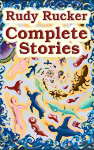
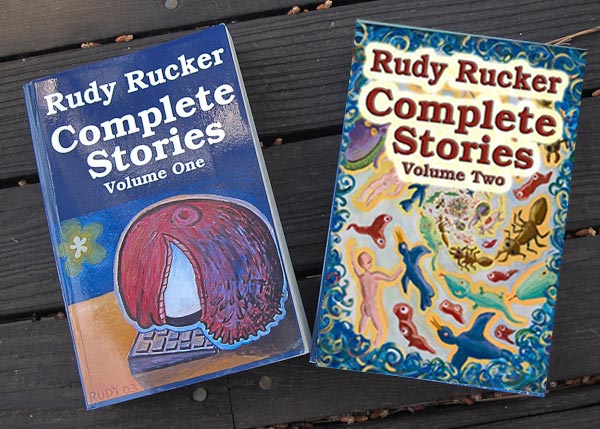
A trove of gnarl and wonder! Complete Stories is now available in paperback from Transreal Books. Two volumes, over 500 pages each. (Note that the combined contents of both volumes are still available as a single two-in-one ebook on Transreal Books.)

$16.00 each.

Volume One, 1976-1995 ranges from the cyberpunk to the transreal, including collaborations with Paul Di Filippo, Bruce Sterling and Marc Laidlaw.

Volume Two, 1996-2011 includes fifteen tales previously uncollected in any paper edition. Features collaborations with Bruce Sterling, Marc Laidlaw, Paul Di Filippo, John Shirley, Terry Bisson, and Eileen Gunn.

And, once again, you can check the Transreal Books page for the combined two-volumes-in-one ebook option.

Today’s two-volume paper edition is for those who enjoy tangible books. As I mentioned in my previous post, I laid out the text with InDesign, and the books look pretty good.

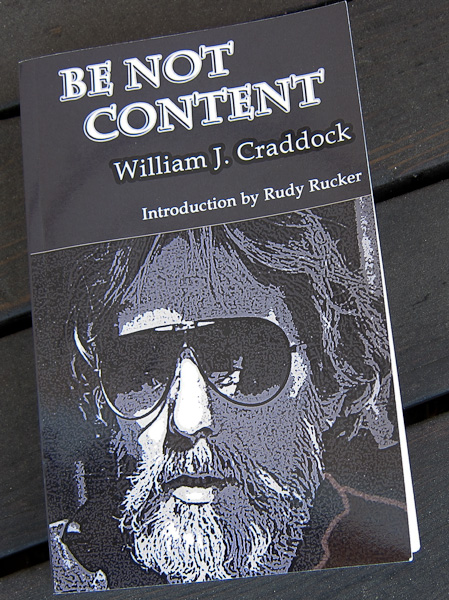
(And, yes, I still expect that William J. Craddock’s Be Not Content will be out in paperback soon, assuming I can straighten out some final details.)

“Garden of Eden,” Mark Pauline, InDesign

Monday, May 28th, 2012

I finished a new painting today, Garden of Eden.


“Garden of Eden,” oil on canvas, May, 2012, 40” x 30”. Click for a larger version of the image.

I started this picture over six weeks ago, on April 9, 2012. My usual partner in crime, Vernon Head, went out for an en plein air painting session with me on the bank of a stream that runs into the south end of Lexington Reservoir . It was a pretty spring day, and we daubed away. The one thing that caught my attention the most was a particular bend in the trunk of a tree overhanging the creek.

So that made it into my painting, but not all that much else about the actual scene. As I’ve mentioned before, Vernon (see his lovely and realistic paintings) always kids me, “Why do you even go look at anything outside, when you’re just going to end up painting a dinosaur and a UFO?”

Well, it’s fun. I worked on this painting much longer than usual—but there’s no rush. Now I just have to start another one. It’s soothing to be out in my back yard smearing around the colors. So non-digital.

Speaking of artists, I saw the legendary SRL artist, Mark Pauline last week, demonstrating his latest creation in a parking lot outside the funky Tenderloin Phoenix Hotel, where an art show was taking place. (That’s not the Phoenix in the background, that’s the Federal Building with the IRS and the FBI, cowed (one hopes) by Mark’s claw.)

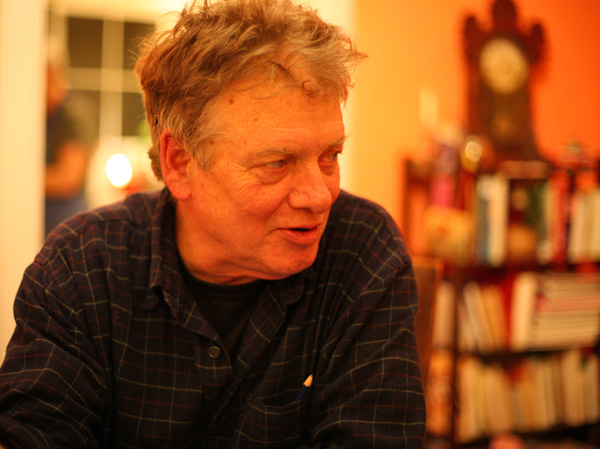
A few of the old hipster faithful were there: Karen Marcelo, V. Vale, and the artist Kal Spelletich. (Karen and Vale shown above.) Mark spoke on a panel before the demo, and talked about “quasi-criminal art”—an inspiring phrase. Then we went outside and Mark did a demo of his new “Spine Robot,” accompanied by his young son, who was eager to play with the controls as well. Here’s a photo of them.

Otherwise I’ve been busy getting my Transreal Books into POD (print on demand) paperback editions as well as in ebook format. I’m almost there. I decided that a Word file doesn’t really look nice enough to be sold as a print book, so I took a big jump and began using Adobe InDesign typographer design ware.

I found InDesign to be the hardest program I’ve had to learn since tackling the Microsoft C++ debugger about fifteen years ago. A learning curve like the face of Half Dome. And the official documentation, as is so often the case, is rather cryptic or even, to put it bluntly, sucks. Googling my questions helped a little.

My basic problem with InDesign—which I still haven’t resolved—is that I don’t have a mental model of the logical space that the program is “thinking” in. It makes a distinction between the “pages” (like of your book) and the “text” (which is what you’re putting on the pages) and to spice things up it has “threads” (which connect some, but not all, of the pages to each other) and “spreads” of, ideally two facing pages (but when you add pages, the new pages sometimes end up being a toilet-paper roll of right-hand pages all stuck together). Here’s the Adobe help page that “explains” it. I’ve read this page, like, fifteen times, and still no joy. The catch, I’ve been learning, is that some of the statements made on this page seem to be untrue or in some way misleading, and if I act on these particular statements, I freeze up my machine.

Never mind. I’m working around the dodgy bits. And with experience the mysteries will slowly clear away like morning mist in the summer sun.

The bottom line, in any case, is the InDesign does really beautiful text layout with clean justification (straight right margin) achieved by varying the spaces between the words, the spaces between the letters (kerning), and even (if you like) a two-percent variation in the actual sizes of the letters. So when you’re done—shaking with fatigue, desperate with confusion, your eyes glazed from scanning obscure screens and Googled-up help pages, your back a knot of pain—when you’re done, the layout looks really slick.

I’ve laid out three books now, and I trust that, as I move forward, it’s gonna be easier.

Sylvia and I took an afternoon off to walk in a park near us where a lot of Canada geese live. Five goslings!

Eclipse, Publishing, Transreal Books

Tuesday, May 22nd, 2012

There was a cool partial annular eclipse of the sun here in the SF Bay Area last week. It was about 6:30 pm, and the sun was going behind the hill that I live on, so I walked up the street to get a better view. I’d been using the safe method of studying tiny crescents via a pin hole punched sheet of paper projecting them onto a black back of a book. But, wearing shades and walking up the tree-crowned hill, I could suddenly see the eclipsed sun directly with my naked eyes.

And, yes, I know you’re not supposed to stare at it, and I didn’t. But I could see it, via quick, raking side-long glances, the suddenly huge-seeming sun a strange crescent just above the horizon, filtered through the scrim of live-oak trees, archaic, mythical, the horned sun.

The patches of shadow-light cast by the trees and bushes were strangely warped, with each dapple-blog cast into a crescent, with an overall effect like taffy.

It felt like a weird sign, a signal from on high.

Moving on, this is strange time in my chosen field of writing and publishing.

Firstly, it seems like there’s hardly any bookstores anymore. The big chains like Walden, Borders and B&N forced out the older small independent bookstores. Then Amazon ate the business of the chains. And now it seems like Barnes and Noble is the only chain left. So far as I know, the only generalized bookstores fair city of San Jose (urban area population of two million) are three Barnes and Noble outlets. Yes, we have a few textbook, foreign language, Christian, children’s, and used book stores too. But those aren’t stores that would stock any books I would write. Even in San Francisco there’s weirdly few bookstores—none at all near Union Square anymore: Borders, Rizzoli, Cody’s have all vanished. Nothing left to do but “shop.”


[A collage of photos of a model in a Jean Paul Gaultier “ant-dress,” on display at the show of his fashion currently running at the DeYoung Museum in SF.]

Secondly, the publishers seem to be on the skids, at least for me. The once-welcoming Tor Books published eight of my books from 1999 ”“ 2011. But now they’re telling me they can’t afford to publish me anymore. My old fall-back publisher Four Walls Eight Windows was bought out by Avalon, who were bought out by Perseus, and their line of books has been essentially closed down. My new fall-back publisher Night Shade Books took six months to pay me my on-publication advance for my last novel, Jim and the Flims, and who knows when they’ll put out a trade pb edition. Night Shade’s finances are so shaky that they don’t want to buy my new books either.

I think publishers are looking more for the narrow, hard-core genre kinds of things. And that’s never been my style ”“ even when I think I’m going that route. Really, Jim and the Flims was meant to come across as supernatural fantasy, but it hasn’t gotten the traction I’d hoped.

Thirdly, ebooks are starting to matter. One of the complicating things here is that the big publishers have been so greedy about the ebooks. For one thing, they’ve been keeping the prices of ebooks artificially high—I mean, come on, all you’re selling with an ebook is an electronic file. For another, they’ve been offering their authors an unfairly low cut of the ebook profits. It’s hard to even figure out what the publisher’s offer is for many of my books that have been ebook-ified, but these days the standard seems to be 25% of whatever money the publishers actually get. A lot of authors’ think they should be betting 50% or even 75% (which is typical for foreign book sales). See this impassioned rant by thriller-author Joe Konrath.


[Typical New Yorker ice-floe cartoon I found reprinted by the Native American site Blue Corn Comics as an example of ethnic stereotyping which, come to think of it, it is. By the way, in 2012, the cartoon would be closer to current trends if the “benefits” fish were a skeleton!]

So, fourthly, I have an ongoing fear of losing all my publishers. There’s a folk myth that, in hard times, the Eskimos, more properly called Inuit, used to set aging tribe members onto ice-floes and let them drift off towards the midnight sun. You imagine the old person getting a piece of blubber or a fish to take on the floe with them. It’s not clear that this ever actually happened, but there’s an odd resonance to the tale, and I think about it a lot these days.


“Turing and the Skugs”, 40″ x 30″ inches, Oct 2010, Oil on canvas.” Click for larger version.

Adrift like this, and still waiting to sell my latest novel, Turing & Burroughs (but with a couple of prospects still pending), I’ve been unable to get motivated to continue working on my next novel, The Big Aha.

So meanwhile, in limbo, I’ve been building up my new publishing venture, Transreal Books. Sort of like a guy digging a fall-out shelter—just in case. The direct, unmediated access to readers via Transreal Books is nice. Turns out I can sell ebooks myself, and I can even sell printed books online as well.

If the biz really bottoms out for me, I’ll probably be using Transreal Books rather than going around to the truly tiny publishers—not always a pleasant process in any case. As a general (but not invariable) rule, the less someone pays you, the worse they treat you.

The catch with setting up Transreal Books is that I’ve had to put in hundreds of hours learning to use the programs Calibre, Sigil, Dreamweaver and, this week, InDesign. Whew.

In a certain way, I enjoy the programming aspects of this. I used to program a lot when I was working as a CS professor and as a software engineer, back in the ”˜90s. It’s kind of like a computer game, really. Addictive, self-destructive, hypnotic. You keep Googling for help, trying things, breaking things, doing rebuilds, and slowly you converge upon the upload and then some sales. Fresh-caught fish on my ice floe.


[My old painting A Square and His Wife, recently unearthed at the offices of Monkeybrains.net, San Francisco’s only independent ISP, now blanketing the Mission with wireless access.]

Drifting towards the great horned sun.


Rudy's Blog is powered by WordPress