[Warning: Rudy Rucker is a fictional character. Do not try injecting conotoxins into your own brain on New Year's Eve.]
 |
 |
 |
 |
 |
 |
 |
 |
 |
Click covers for info. Copyright (C) Rudy Rucker 2021.
[Warning: Rudy Rucker is a fictional character. Do not try injecting conotoxins into your own brain on New Year's Eve.]
As I keep saying, for the last couple of years I’ve been working on a long book with a long title, The Lifebox, the Seashell and the Soul: What Gnarly Computation Taught Me About Me About Ultimate Reality, the Meaning Of Life, and How To Be Happy.
Here's another excerpted idea. I'd wanted John Brockman to put this on his annual Edge Question of the Year page, but he thought it was too complicated. Like, the regular Godfather makes you an offer you can't refuse; but the Mathematician Godfather makes you an offer you can’t understand…
Here we go.
Think of a computation as an ongoing process, for example your life, or society, or a plant growing, or the weather. Relative to a given computation we can formulate the notion of a target state as being some special status or behavior that the computation might eventually reach. The halting problem in this context is the problem of deciding whether a given input will eventually send your computation into one of the target states. And a halting problem is unsolvable if there's no computation, algorithm, or rule-of-thumb to detect which inputs won't ever produce a target state.
By way of getting a more defendable form of Wolfram's Principle of Computational Equivalence [registration required], I've formulated the following Natural Unsolvability Hypothesis (NUH):
Most naturally occurring complex computations have unsolvable halting problems relative to some notion of a target state.
The table lists a variety of real world computations to which the NUH might apply. In each row, I suggest a computation, a notion of “target state”, and a relevant question that has the form of wanting to detect initial states that fail to produce a target state.
|
Computation |
Target States |
Unsolvable Halting Problem |
|
The motions of the bodies in our solar system. |
Something rams into Earth. |
Which possible adjustments to Earth’s orbit might make us safe? |
|
The evolution of our species as we spread from world to world. |
Extinction. |
Which possible tweaks to our genetics might allow our race survive indefinitely? |
|
The growth and aging of your body. |
Developing cancer. |
Which people will never get cancer? |
|
Economics and finance. |
Becoming wealthy. |
Which people will never get rich? |
|
Economics and finance. |
Going broke. |
Which people will never go broke? |
|
Crime and punishment. |
Going to jail. |
Which kinds of careers allow a person to avoid incarceration forever? |
|
Writing a book. |
It’s obviously finished. |
Which projects are doomed from the outset never to be finished? |
|
Working to improve one’s mental outlook. |
Serenity, tranquility, peace. |
When is a person definitely on the wrong path? |
|
Finding a mate. |
Knowing that this is the one. |
Who is doomed never to find true love? |
|
Inventing something. |
Eureka! |
Which research programs are utterly hopeless? |
Assuming that the NUH applies to these computations with these particular definitions of target state, we’re faced with unsolvability, which means that none of the questions in the third column can be answered by a finding a simple way to detect which inputs will set off a process that never leads to one of the target states.
In such cases, all you can do is watch and wait, maybe forever. In a way, it's no surprise.
So I’m going on about cellular automata all the time and you’re thinking, “Yes, but can CAs get me high?” I’ll say! Stephen Wolfram’s mascot is the textile coneshell, famous for having a one-dimensional CA wrapped around its shell.
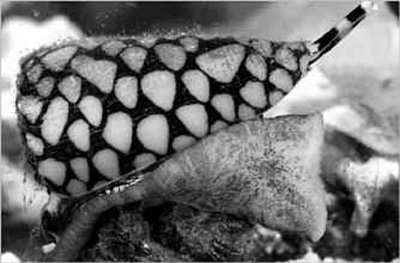
Now as it happens, these little guys are fierce carnivore predators, prowling around in search of small fish to harpoon. See the Cyber Diver News Network for details.
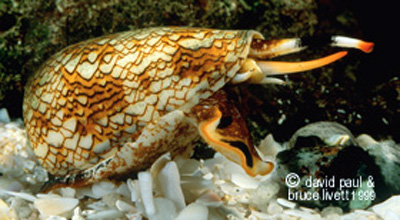
The harpoon is a tiny barb laden with a venom called a conotoxin!
(These two pictures are from a conotoxins interest group.)
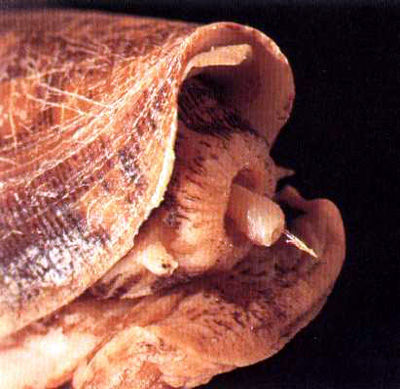
And today an article in the Washington Post [registration required to view] reports that a new conotoxin-derived pain-killing drug named Prialt has been approved. And we know all about “pain-killers,” right? Prialt is said to be a thousand times as strong as morphine. It’s so powerful that if its injected into your muscles or blood stream, it stops your heart — the only way to take Prialt is to inject it into your spinal cord so that it goes straight to the brain. And, natch, a relatively common side-effect is hallucinations.
The world broke into cellular automata, at first in patches and then in chunks. A pair of gliders scuttled by, unweildy as crabs on stilts. As I spoke, the sounds from my mouth became long strings of oscillators. And then a Zhabotinsky jellyfish engulfed me.
Today another quote from The Lifebox, the Seashell, and the Soul, upon which I'm laboring these days. This quote is (C) Copyright Rudy Rucker, 2004.
Let's start with a looooooooong picture of a one-dimensional cellular automaton in action. Think of space as the horizontal direction, and time as the direction running down the page.

I want to mention a touchy subject: God. Let me immediately say that I’m not out to advocate religion. If you want to keep things more neutral, think of “God” as a convenient and colorful synonym for “the cosmos”. Or think of the “God” word as convenient shorthand for “the unknown.”
My reason for mentioning God is that there’s a particular connection between God and free will that intrigues me: When in dire straits, people sometimes ask God to help them change their behavior. And, often enough to matter, this seems to help them get better. What might this mean?
I would say that becoming desperate enough to turn to God involves recognizing a current inability to alter one’s mental patterns, and a desire to attempt some higher-level change. The plea expresses a longing to jump out of a loop; a desire to move from one attractor to the next; a wish to experience a chaotic bifurcation.
If the plea works, does that mean that the Great Author, the Ground of All Being, the Omnipresent-Omnipotent-Omniscient One has reached down to change the parameters of some suffering character’s mental computations? And, more to the point, does this destroy determinism?
Well, we can keep determinism if we allow for a less supernatural view of reform-by-supplication. We could simply say that asking God for help has an organic effect upon a person’s brain. In other words, expressing a desire to have a spiritual life might activate, let us say, certain brain centers which release endorphins that in turn affect the threshold levels of one’s neurons. And these changes nudge the brain activities to a new strange attractor. A deterministic chaotic bifurcation occurs.
Do I really think it works like that? Well, to be truthful, I’ve always felt comfortable about reaching out for contact with the divine. The world is big and strange, and we have only the barest inkling about what lies beneath the surface.
But even in this less materialistic view, a person can still be deterministic. Asking God for help in achieving a chaotic bifurcation is really no different from asking a doctor for penicillin. You can’t will an infection away, and you can’t will yourself to abandon some deeply ingrained bad habit. But at slightly higher level, you may be able to muster the will to get help. And this higher level is, after all, simply part of your brain’s ongoing deterministic computation.
For that matter, God, too, could be deterministic. In the context of the theory I suggested in an earlier entry, God could be a deterministic non-reversible class four paratime metaphysical cellular automaton.
But that sounds so dull. Better to say the cosmos is dancing with us all the time. And that God is in the blank spaces between our thoughts — like in the white regions of the picture of the deterministic “China CA” shown above.
Regarding the image, it follows a one-dimensional CA through six hundred generations. The world of this CA is 128 cells wrapped into a circle, meaning that the right and left edges of each strip match. If we were to paste everything together, this picture would be a cylinder like a baton. Notice the characteristic feature of class four rules: they send information back and forth between different regions by means of the moving patterns that we call gliders. I discovered this rule after about fifteen minutes of a Blind Watchmaker-style directed search. I call it China because it looks a little like a silk fabric design. Image made with CAPOW.