Click covers for info. Copyright (C) Rudy Rucker 2021.


Archive for the ‘Rudy’s Blog’ Category

Micronesia 11: Kayaking Rock Islands of Palau. Universal Automatism.

Wednesday, March 16th, 2005

Yesterday I went on a kayak tour in the rock islands, it was called “Jake’s Tarzan Tour.” It was one of the best days of my life.

Our guides were three Palauans: Jake, Ding and Rayna. They were great: wild black natives, talking rapid-fire Palauan to each other all day, Jake was the very image of the old-style Polynesian chief, though later I found out he’d gone to college, started a career as an accountant, and thrown that over to be a tour guide.

There were five of us tourists. They loaded up five single-seat hard kayaks on a boat and motored out to our starting point. For the rest of the day, we kayaked in stages: we’d get to a location and the motor boat would be waiting there, we’d tie our kayaks to the boat, go snorkeling, climb up the ladder to the motor boat, replenish our supplies, and then remount our kayaks. Jake had six waypoints for us: a hidden underwater tunnel leading to a tree-lined lagoon filled with giant clams, and a sunken ship from the 1930s.

And then a little point where Jake speared a fish, a large lagoon with a beach where we had lunch, an underwater tunnel leading to a cave filled with blue light coming up from the water, and an arch connecting two bays with soft corals growing on the sandy bottom of the arch.

We must have skirted the edges of two dozen islands, none of them were all that large. Their edges are eaten away by the ocean so they stick out of the sea like muffins. In kayaks we could get far under the ledges of the islands. Little stalactites hung down, the turquoise waves lapped at the rocks, tree leaves drifted about. The islands themselves are less lush than I’d realized. From a distance they’re solid green, so one thinks of a jungle. But the greenery is more like a thin layer of icing on a base of stark and toothy gray rock, porous limestone that’s been eaten away into thousands of little blades and spikes. As humus collects in the pockets of rock, seeds take root and grow trees, some of them quite large.

Coming into the lagoon for lunch I felt quite weightless; the water was so clear and unrippled, and the sand below it so white. It was as if my kayak were gliding through empty space. And quiet, quiet, quiet all around. Not a whisper of wind in the trees, only the gentle lapping of the waves, the occasional calls of birds and, of course, the sporadic whooping of the Palauans. I had such a wave of joy, wading around that lagoon, and a profound sense of gratefulness, both to the world for being so beautiful and to God for letting me reach this spot. I had another wave of these feelings a bit later when we were kayaking through a maze of small islands in shallow water, bays that no motor boat could reach. Peaceful, peaceful. Eden. The world as it truly is meant to be. Thank you, God. I’m glad I lived long enough to get here.

High in the air above one of these sunny backwaters, I see a large dark — bird? It’s the size of an eagle, and, no, it’s a fruit bat, the sun shining through the membranes of its wings. The islands look like green clouds come to earth; mirroring their fluffy white brethren above.

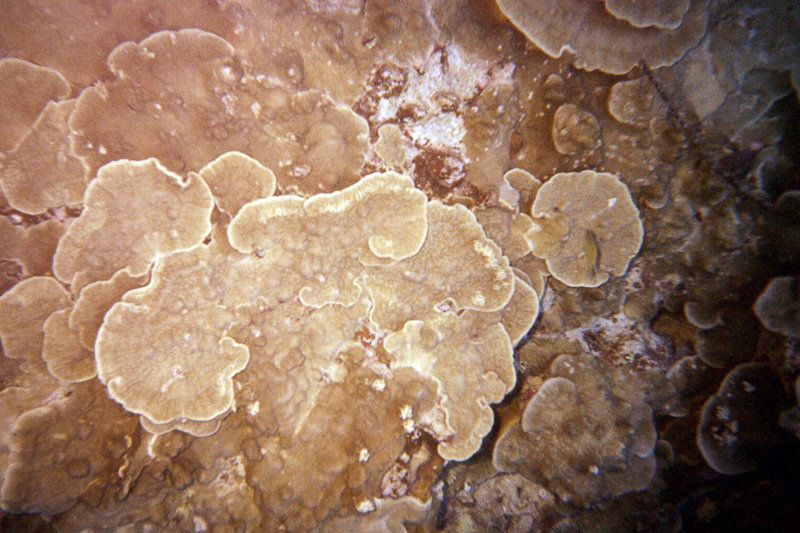
In the last snorkel spot there are lovely pale blue and pink soft corals, branching alveolar broccolis on the sandy bottom of the archway connecting two bays. Fractals, in short. Swimming through the arch, I encounter a shoal of maybe ten thousand tiny tropical fish, like the fish you’d see in someone’s home aquarium, little zebras or tetras. With my snorkel on, I marvel at their schooling motions, their bodies moving in a unison like iron filings in a field, their ropes and scarves of density emerging from the parallel computation of their individual anxieties. The turbulent water currents compute, the clouds in the sky, the cellular automaton reaction-diffusion patterns on the mantles of the giant clams, the Zhabotinsky scrolls of the shelf corals, the gnarly roots of plants on the land.

And I’m thinking that maybe, yes, maybe after all everything is a computation. Universal automatism gives me a point of view from which I can make sense of all these diverse forms I’m seeing here. Maybe Wolfram is right to chide me for “taking it all back” at the end of Lifebox. But what about my thoughts, can I see those as computations too? Well, why can’t they just be fractal broccoli, flocking algorithms, class four turbulence, cellular automaton scrolls. I ascribe such higher significance to them, but why make so much of them. Are my thoughts really so vastly different from the life forms all around me in these lagoons? Why not relax and merge. All is One.

And if I find it useful to understand the One’s workings in terms of computation, don’t think that this reduces the lagoon to a buzzing beige box. The lagoon is not reduced, the lagoon is computing just as it is. “Computing” is simply a way to speak of the dance of natural law.

Speaking of dance, when we got back to the dive shop, Jake and Rayna were kidding around with this nice, cute American girl who’s just moved to Palau and is supporting herself by working at the shop — I met her the other day because she came along on the Blue Hole dive on her afternoon off. And Jake and Rayna start dancing and chanting, crouched, facing each other, their hands shaking in their air, slapping their thighs, vital and joyous as a pair of indestructible cartoon characters. Archetypes.

I mark this day with a white stone.

(Which is what Lewis Carroll used to write in his journal on his very best days.)

Micronesia 10: Jellyfish Lake.

Tuesday, March 15th, 2005

To cap off the Blue Corner dive day we visited Jellyfish Lake. I heard about this place about ten years ago, when I went to the “Planet of the Jellies” show at the Monterey Aquarium with Bruce Sterling — later we wrote a story “Big Jelly” together about giant flying jellyfish. These special Palau jellyfish barely sting, they don't eat anything, they get their nourishment from algae cultures that live inside their bodies. All they do all day is pulse their bells so as to move themselves into the sunniest part of the lake to make the algae in their tissues grow. Shades of my moldies in Freeware!

[Painting I later did.]

We swam out into this lake about a hundred yards, wearing masks, snorkels and most of us with fins. Keith, our guide, said the visiting ctenophorologists studying this population estimate it's now fifteen million strong, although in the bad El Nino year it had dropped to virtually nil, with nothing left but some estivating spores or polyps.

[Unrelated photo of swarming gnats in the air, the lines are the trails of their bodies, and the little tick-marks are their wingbeats.]

So how was it? It put me in mind of a certain kind of program I used to have my computer graphics students write. You define the geometry of some graphical object — we used to use polyhedra or tori — but in this case its a rounded bell with four dangling clappers, positioned like table legs, with lots of bumps along them. And you fill space with objects of this kind with randomly selected radii, or better than random, select the distribution according to a power law so you have, say, a certain number of large four inch diameter jellyfish, twice as many two inchers, four times as many one inchers, eight times as many half inchers, sixteen times as many quarter inchers. And maybe none smaller than that. You randomize their directions of motion, the jellyfish seem to have no inkling of up or down, although they are ever so slowly heading towards the light, this doesn't prevent them from pulsing down for twenty feet or so before getting turned around. You animate them by giving them a repetitive motion. In this case its pulsing.

Now I have a theory about jellyfish pulsation. There's a CA reaction taking place in the cells of the bell that leads to moving waves of excitation. The waves move radially out from the center. The waves travel at the same speed in the flesh of any jellyfish, large or small. When the wave hits the rim of the bell, you see the effect of the bell pulsing, or contracting, thus propelling the jellyfish in the direction of the bell's summit. My insight in the water today is that if a jellyfish is half as big as another, it will pulsate twice as fast. More precisely, if a jellyfish bell has radius R, then it will pulsate A/R times per second, where A is a constant having to do with the effective speed of the reaction wave fronts in jellyfish flesh.

So I'm looking down at them with a scientist's eyes. But also it's completely spacy, there's nothing in the visual field but the greenish yellow sunlight water and the endlessly many jellyfish. A couple of times I dove down to twenty feet, then floated up, with them all around me, no real standard of location or direction, just jellyfish everywhere endlessly.

How densely packed were they? At the thickest regions, there might have been twenty or fifty of them touching my body at any one time, four big guys, eight smaller, sixteen smaller, thirty-two tiny ones, like that. Maybe more. I'd feel something smooth touching me an think I was brushing against another person. Just a jelly.

They stung ever so slightly, and the longer I stayed in, the more I could feel the venom. Particularly when I was free diving down through them, I'd feel tingles on my lips when they touched them. Writing about this, my skin is crawling. Quick, rush to the emergency room. The closest one would be, um, Manila.

“Jellyfish like that very hot for two three week, then — wearing the Happy Cloak.”

After seeing jellyfish preserved behind glass in Monterey Bay Aquarium, what a romp to be able to wallow in them. Almost too good to be true. They have three other Jellyfish Lakes that people can't go in at all. They're a little worried that too many people are visiting this one, Palau seems to be a mass tourism destination for Taiwanese in particular, so maybe the days of swimming freely with the jellyfish are limited. Get 'em while you can.

Micronesia 9: Diving in the Rock Islands of Palau.

Monday, March 14th, 2005

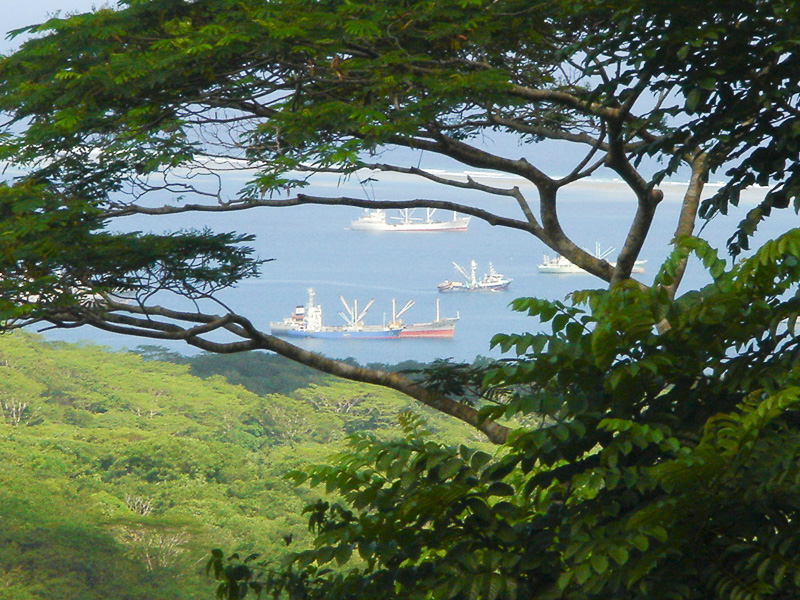
So today we rode a boat for an hour down to the lower end of the Palau archipelago where the best dive sites are. It was a lovely ride, passing scores of muffin-shaped rock islands.

Paradise. I'm finally in Palau. I've been looking at pictures of it and wanting to come here for twenty years. We went with this great dive operator called Sam’s Tours.

The first dive was so-so, Coral Garden with most of the coral dead from an El Niño a couple of years ago, the second was one of the best ever, as good as the Somosomo Strait in Fiji. It was called Turtle Dropoff or Big Dropoff, a spot where a three-foot deep reef suddenly drops down 2,000 feet into the abyss. The tide was running, which meant we just drifted along the wall, down at about 50 or 60 feet. Moving really fast, like almost at bicycling speed, the wall streaming past, covered with waving soft corals like casts of a person's lung passages, like prickly pears, like bushes and bowls and brambles. Schools of fish high above us, fish all over the wall, fish below us, and out in the deep water, over and over, five-foot-long reef sharks. They beat their tails in a rhythm that seems sullen, sulky, slow, skulking. Not really sneaky, though. Sharks don't have to sneak. Maybe the thing that differentiates their motions from that of other fish is that the sharks are the only guys who aren't worried about someone else eating them. They're not all twitchy and jittery and birdlike and abrupt. Nobody's gonna rush out and bite them. They can friggin' well relax, and never mind about the manners. You don't like it, whatchoo gonna do about it?

At one point I'd drifted out to the front end of our party of seven, and I saw a really big shark coming right along the wall, not more than twenty feet away, and now here come something else out of the deep, a hawksbill turtle three feet across, swimming dead-on straight for my head, I saw deep into his eyes. Swimming right below the turtle was something big and flat, at first I thought it was a ray, but it was a fish fully as big as the turtle, swimming on his side so as to take advantage of the turtle's wake — on the surface the guide told me, “That's a bat-fish. He eats the turtle's shit.”

The same bunch of divers went out together three days in a row, it was interesting getting to know them. There were two cute Chinese women, sisters from Shanghai, but one of them, call her Shirley, now lives in, natch, Santa Clara near my home San Jose, she owned a restaurant in Milpitas near all the high tech companies, but sold it. Shirley's younger sister, call her Min, lives in Macao (now spelled Macau), which they described as the Las Vegas of China, it has a reputation as a wide-open Sin City. Both were married, but their husbands weren't along.

At one point we saw a school of dolphins, swimming along at the prow of the boat.

click on this link to see a 5 Meg MPG: movie of the dolphins. (You can hear the Chinese women talking about them in the background.)

There was a guy called something like Bob on the boat, a Texan who's lived in Taiwan for quite a few years, making a living selling custom robots to chip fabs. Big talker, big Texas accent. He has a Taiwanese girlfriend, so has some expertise with Chinese women, and he was bragging to me about how he was going to try and get a date with Min, how Asians all have open marriages and it's not like the uptight USA. And then this morning he's saying something along these lines to Min's sister Shirley, about Asian sexual mores being different, and Shirley is like, “Who say? Why it different?” So much for that theory. And then Shirley tells me that Min's husband owns a casino and two hotels in Macao. To my mind, this calls up an image of a fairly tough character. A guy with an implacable security staff, a private army of martial arts warriors, right. So I'm thinking Bob's odds aren't too good.

Bob was always touching me and Embry when he talked to us, on the arm, on the back, patting and glad-handing, and we privily agreed spending that six hours a day in a small boat with Bob was getting to us. So I took Bob aside and asked him not to touch me anymore. I told him that my brother and I had grown up in the hills of Kentucky and that back there when you touched someone, it meant you were about to punch his nose, so it made me edgy to have him coming up and patting my back all the time, I wasn't sure how I might react. So he stopped doing it, which was a relief. Embry didn't hear me tell Bob this, and was of course delighted when I told him later. To get in on the fun, the next day Embry told Bob that he'd seen Min's husband on the dock, and he was a Chinese gangster in a Shantung silk suit, with two really big bodyguards. The Rucker brothers messing with Bob's head.

All this by-play if you just mix together a dozen people for three days. We're such social organisms. Like fish.

Anotehr time we did Turtle Cove, we went through a hole in a reef, came out on wall and drifted, passing quite a few turtles. Then we did another hole dive, Blue Hole, in which we floated down eighty feet through a vertical shaft in come coral and came out into this immense cathedral-like space. Not all that many fish in there, but the guide showed us a fire scallop, which he prefers to call a “disco clam.” This thing is a shell, which is open, and it has undulating lips with iridescent white lines flashing on and off along the lips, and some kind of protruding from the center is some gnarly soft grabbing device, waiting to snag curious fishies or shrimplets. Then we drifted along a wall towards Blue Corner, not quite getting there.

After one dive day, I felt like getting off on my own, so instead of getting a ride home with the dive charter guys, I walked to a bus-stop, looking around. Seemed kind of like I imagine Jamaica, colorful, lots of dark-skinned people (the Palauans), and reggae music seemingly playing everywhere. Bob Marley, “No Woman, No Cry,” I was remembering first hearing that when Sylvia and I were in some sense exiles from the US, ex-pats in any case, living in Heidelberg, and how strongly I shared Marley's images of the glory of the downtrodden.

I did yoga on a dock for half an hour, beat old boats around, sun going down, very mellow, listened to a whole side of Marley from a nearby bar as I did it. Nobody bothered me. When I walked up by the bar, really a patio, I stopped to study a trail of ants. In the setting sun, they had shadows a quarter of an inch long, magnifying their motions wonderfully. I could hear a guy talking in the bar, a young heavyset guy with a shaved head, a face like a white marshmallow with a few holes in it, like the Pillsbury dough-boy, he has a very heavy-duty underwater camera on the table behind him, he's pitching, “Bottom line, bottom line, I get that slide up, I'm sellin' Palau.”

On my last Palau diving day, we did the classic Palau dive, Blue Corner, where the Philippine Sea meets the Pacific Ocean. We went down a wall covered with hard and soft coral and drifted with the current. Out in the open sea were big sharks, considerably larger than me, some of them. Not all that far away. We were at about 70 feet. There was a swirling whirlpool of big-eyed trevalleys, each of them trying not to be out on the edge where the sharks were. Like a slow cyclone, making a shape like a nest, with every now and then a bright flash as one of the fish turned onto his side to wriggle deeper into the core. These were big fish. Clouds of little butterfly-looking fish, yellow and white like confetti. Up above a school of several hundred barracuda. Then a turtle paddles off the lip of the reef sixty feet above us. And then an eagle ray with a fifteen-foot wingspan flaps by.

The greatest dive of my life.

Micronesia 8: Arriving in Palau

Saturday, March 12th, 2005

It's a 30-40 minute drive from the Palau airport, across two or three bridges to our hotel. On the way we go through downtown Koror, the capital of Palau, so far it seems like a crumbly third-world shopping strip, stores, hotels, restaurants, steady traffic on the two-lane road. We pass a local baseball game. Our hotel is out at the end of another island. In the evening we take a free bus into Koror and walk around, it's exciting, so alien. Unlike Yap, there's no one main race here, it's just totally polyglot: Indonesians, Chinese, Japanese, Palauans, Koreans.

We went into a market to look for film, it was wonderfully bizarre. The only newspaper for sale was the Weekly World News of January 31, 2005. Headline: “UFO Washed Ashore By Tsunami.” With a large black and white photo of a pie-pan UFO superimposed upon the wreckage of Phuket.

Somehow I'm reminded of the Interzone, the hallucinatory city in William Burroughs's Naked Lunch. Not that I'm seeing people doing anything particularly louche, but it feels utterly outside normal reality in that same way. For maybe the five hundredth time in my life I think of this line from, I think, The Soft Machine, and chuckle. “You win something like jellyfish, meester. Or it win you.”

Walking into his hotel room, Bradley saw something high in one corner of the ceiling, a gauzy veil, like the mucus casing that a parrot fish exudes to cocoon itself in when sleeping. The shape fell down upon Bradley faster than he could form a complete thought; it slid inside his shirt collar, down inside the band of his trousers and underwear, down his legs and inside his sandals. He felt a sexual burning in every nerve. The boy who'd spoken to him in the street, appeared in his doorway, his lips as bright red with betel nut as if he were a vampire.

“Skin like that very hot for two three weeks,” said the boy. “Then wearing the Happy Cloak.”

We took a gypsy cab from the airport to the hotel, driven by a betel-chewing guy called Ted. I forgot my knapsack with my prescription diving mask and my laptop computer in the back seat, realized this only in my room. But Koror is small enough that the bellman knew exactly who'd driven us, and when he couldn't raise him on the phone, sent a guy into town to find him. Half an hour later I had my bag back, and showered large tips on all parties concerned. I have been backing up my diary and novel onto my minidrive, so it wouldn't have been a total disaster. But I'm so glad to still have my little thinking aid. My axe. My memory seems a notch worse than it was the last time I traveled. Sometimes it feels like I'm traveling in a Heisenbergian haze, with all my possessions smeared out in probability space around me, at any time apt to quantum-jump out of my ken.

The hotel is very comfortable, but in some ways a let-down after Yap. Very corporate, polished, mega. Right on a nice beach, but they have such an immense ventilation system over the kitchen that the entire beach is flooded with the roar of fan. Additional machines are all over the place, and when we checked in they were actually, *sob*, leaf-blowing the driveway, which is something I definitely hear enough in California. But, again, the room is super-comfortable, solid, clean. And, really, how dare I complain at this point.

This morning I took a walk in a jungle beside the hotel, and heard an amazing bird song, three tones like a squeaky door, do-mi-(ti below do). And another bird doing a rising coo-coo-coo-coo call, though without ever breaking into the frantic squawk one expects.

The beach has a lot of coral, starting about twenty feet out, at depths ranging from four to eight feet. I went in snorkeling right away with Embry, saw scads of tropical fish, most notably a slowly whirling school of parrot fish — these guys gnaw on the coral, they have a very strong beak-like mouth, and they're shaded in lovely blues and greens. They have this cute tiny chartreuse (brilliant yellowish light green) fins like bird wings.

And best of all, the beach is loaded with giant clams, I saw one little “garden” of ten of them, each shell easily three feet across. Big crenellated shells, cracked open about a foot, and stretching across the opening is the clam's mantle(?) with two holes in it, a dot and a slit. The mantles are patterned in the most elaborate and psychedelic fashion, a bit like marbled endpapers, a bit like tie-dye. No two of them seem to be the same, even regarding palette of colors. I already wrote them into my novel-in-progress, where I describe a futuristic computing device that has this exact appearance, to wit:

“The skin was undulating, with slight ripples moving back and forth across it, interacting to form delicate filigrees and fleeting moirés, like a living piece of watered silk. The skin was spotted and striped with blues, greens, aquas, yellows, and purples — like a cellular automaton, like an old book's marbled endpapers, like the mantle of a giant South Pacific clam.”

Some guys similar to the clams, a type of scallop with the same brightly colored mantle and lips, wedge themselves into holes in the coral heads, so that, in the middle of the a large maze-patterned brain-like coral orb you'll see a pair of iridescent blue or green lips, leopard-spotted with black or brown dots, as intricately detailed as the borders of the Mandelbrot set. [Actually the latter three of the pictures here are of those scallops, I only got the one good picture of the giant clams, although later we met a diver whose hobby is photographing giant clams, so eventually I may get a link to her site.] Turning on the SF reality-warper, I can readily visualize the people of 2100 instilling cultures of algae or Pacific giant clam cells into their lips or private parts so as to achieve some startling and magnificently iridescent effects. Is this really so inconceivable in our present world of Botox and silicone? Mightn't the 2100 Superbowel Halftime Show involve, let us say, a fading star's “accidental” display of her really quite stunning new biocosmetics?


Rudy's Blog is powered by WordPress