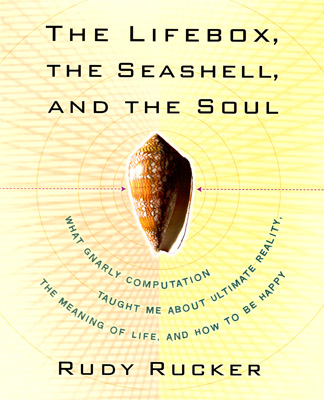

I got back from Wyoming just in time to turn around and fly out to Cambridge, Mass, for a scheduled talk and book-signing at MIT, promoting The Lifebox, the Seashell, and the Soul.
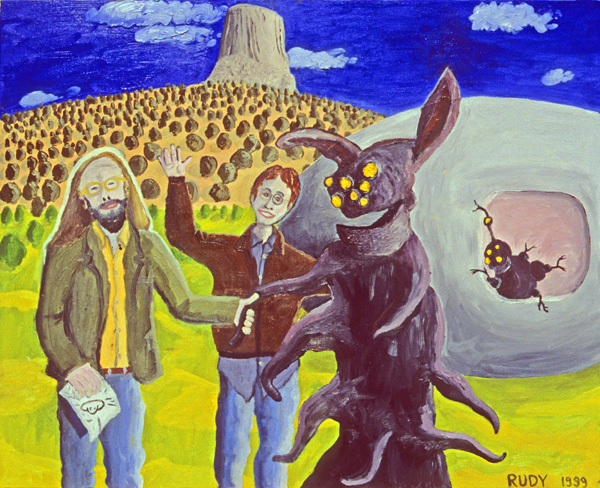
While I was in town, I managed to go see a premier production of (part of) my musical-theater piece, “Mamma Infinity UFO,” a reworking of the play “As Above So Below” based on my short story of the same name, a tale about a mathematician who encounters a UFO shaped like a 3D Mandelbrot set. (Not to be confused with my novel about painter Pieter Bruegel bearing the same title.)
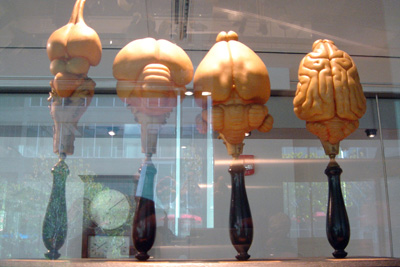
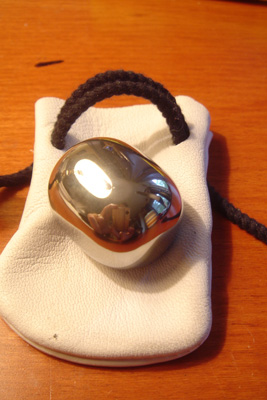
[Set of models of brains on sticks like lollipops or sex-toys in the Harvard Hall of Science: crocodile brain, pigeon brain, rabbit brain, dog brain.]
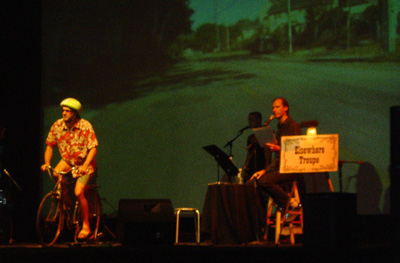
The Elsewhere Troupe producing my piece only had ten minutes of it worked out; they performed that as part of the Keep Santa Cruz Weird Festival, which was a variety show of different acts in the funky old Rio Theater (a repurposed movie theater) in Santa Cruz that we always pass on the way to the beach. They bill also featured a ukulele band called the UkeAholics, a juggler, a cowboy psychedelic story-teller, a pretty girl carrying title cards, a woman singing rap and opera, experimental movies, and more. Naturally the one act that was so weird that it left the audience temporarily speechless was mine. I’ve seen that effect so often, the stunned silence when my presentation stops. And to me what I’m offering always seems so clear and logical, a gentle extrapolation from familiar facts. In any case, it was great seeing the show, it’s a trip to see my personal psychic states being publicly dramatized.
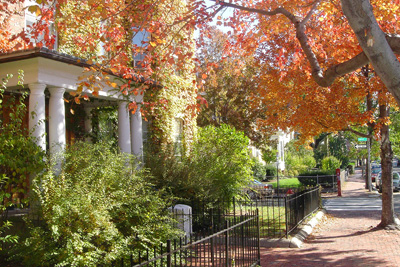
And then a few days later it’s 6:50 AM; I’m lying in bed in “A Friendly Inn,” a bed and breakfast place in Cambridge, Mass, a classic New England rooming house, only run by Chinese, my room feels almost like a dorm room, here a block away from Harvard Yard, which is the several-city-block compound of buildings and quads making up this quintessential university’s classic core. I see lovely red and yellow autumn leaves out the windows against a clear blue sky, reminding me of days like this forty years ago when I was at Swarthmore.
Harvard was my first choice for a college as a bright high-schooler in 1963, and I didn’t get in, perhaps because of my I-want-to-be-a-beatnik application essay and the I-am-an-existentialist interview I had with a disapproving stock-broker Harvard alum at his office on Market Street in Louisville. Me: “I admire Kerouac and Jean Paul Sartre.” He: “Have those fellows — have those fellows ever met a paycheck?”
For years I carried a resentment of Harvard, the Ivy League, Boston, and even New England as a whole. Yesterday I was sitting alone in the Memorial Church in Harvard Yard, recalling this, and thinking that, after all, it was very good to go to Swarthmore — and I made some progress on setting down that old resentment. Harvard is cute, the best, I’m glad it’s here. I walked into some of the classroom buildings, following the students up the stairs, getting glimpses of the Genuine Harvard Classrooms, with actual chalk blackboards. Wandered into a student dining hall with wood wainscoting and enormous chandeliers (and was immediately evicted — “But I’m a National Merit Scholar!” “Outta here, you beatnik.”). This place really is the platonic ideal of an East coast university.
Thinking back to 1963, I could have gone to MIT, where I applied and was accepted, but on my college tour, the school had struck me as too — what was the word I would have used then; we didn’t use “nerd” or “geek” or “dweeb”? Sliderule? Martian? Engineer? My people, now.
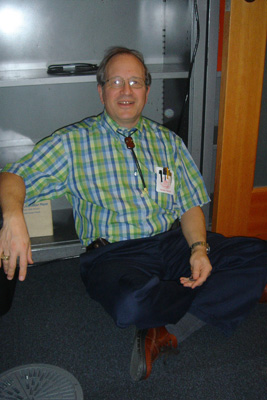
(Heres a photo of Gerry Sussman wearing a “Nerd Pride” pocket protector, I ran into him at MIT this time out, full of ideas, charming, lively, he’s been there 41 years, was two years behind hacker Tyrannosaurus Rex Williaminus Gosper.)
I remember the guy who gave me my MIT campus tour back in 1963 said, “This is the dorm I live in, and some people call it the ‘tool shed.’” “Tool” at that time being a word with some of that same force. But at Swarthmore I saw wide-hipped long-haired girls in jeans sitting on the grassy lawns talking to boys, and I knew this was for me.
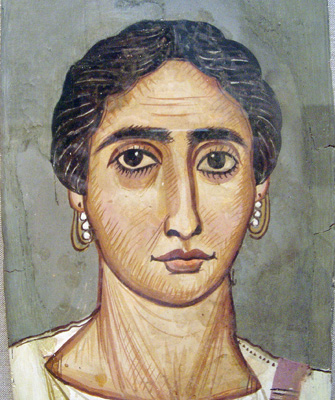
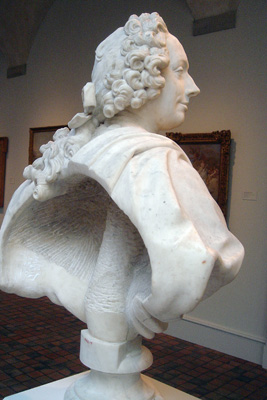
Back in the present, at Harvard I walked around the Fogg Art Museum; saw some good stuff like this Roman portrait buried with this person’s mummy.
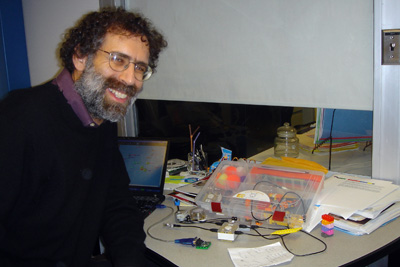
At MIT I was the guest of my old artificial-life-researcher friend Mitch Resnick of the Media Lab, we met at Alife 1 at Los Alamos in, like, 1987. Mitch has been working with the Lego company over the years, and is now guiding a Lego spin-off startup company Playful Invention Company with a product called the PicoCricket Kit; their aim is to make robotics kits that might appeal to girls as well as to boys. The idea is to involve sound, color, and touch; to make the devices more haptic and sensuous. He says that over the years the Media Lab has become more and more hardware oriented.
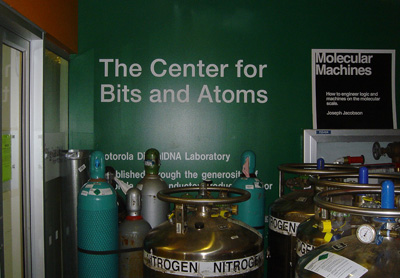
Next door to Mitch was the “Bits and Atoms” group, focused on, I think, computational DNA. And a few doors down were some guys making walker exoskeletons under, I believe, a grant from DARPA.
One bittersweet thing about a place like MIT is that the projects one hears of or remembers are often thesis projects which, after a few years, are gone. Always new stuff coming up. One thing I wish I could have seen again was an old Media Lab demo in which a student was stacking up the frames of movies to make virtual 3D objects, sensuous spacetime trails.
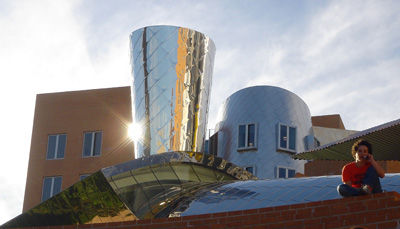
We didn’t have time to tour all of the Media Lab because we took time off for lunch at CSAIL (Computer Science and Artificial Intelligence Lab), which is now the coolest building on the MIT campus, a Frank Gehry work. We had lunch with CSAIL director Rod Brooks, he of the Attila, Cog, Kismet, and Roomba fame, coiner of the robot-liberation slogan, “fast, cheap and out of control,” and author of the fascinating book Flesh and Machines. I think the fact that I’m an SF writer impresses these guys more than my work on CS. SF is something they can’t do.
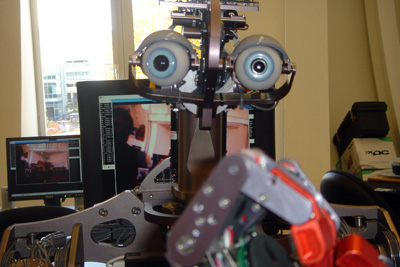
I got to see a few new humanoid robots under development by grad students in Rod’s lab. I was particularly impressed by one named Domo, Rod got me to feel Domo’s hand. Domo’s fingers were so gentle and responsive, like a human’s.
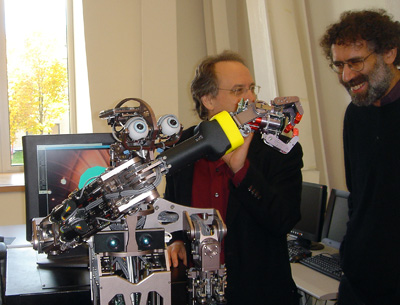
Domo had a gazillion springs in his fingers and arms. He was learning to watch his hand with his eyes, staring at his fingers like a stoned deadhead, with a video screen behind him showing his view with an aqua disk of variable size to indicate the region, if any, that Domo was focusing on. If nothing was happening, the disk would go away, but if I waved my hand in front of Domo’s face, he’d wake up and follow my motions, his eyeballs moving and the aqua disk tracking my hand on the screen. That’s Rod in the background.
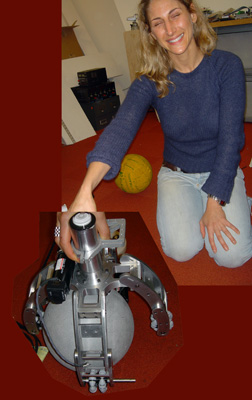
A student called Jessica Banks showed me a little robot that was learning to balance on a bowling ball; it was called Eggway. “Can I take your picture for my blog?” I said. “Oh, I get this all the time,” she said, enjoying the attention.
When it came time for my talk, I encountered the all-too-familiar problem of the computer projector not working with my (brand new) computer. But I’d posted my “Gnarly Computation” slides to the Web in advance, and was able to show them using the room’s built-in computer, also I had time to download and install my demo cellular-automata software CAPOW on that machine before the talk. I taped my talk for a 60 Meg MP3 podcast.
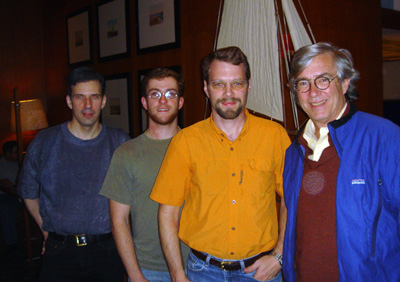
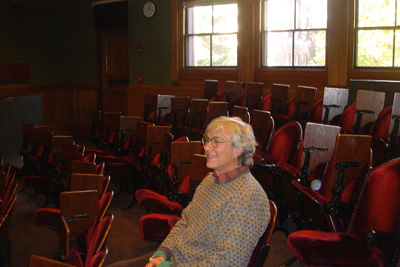
Afterwards there were three guys hanging around (from right to left): Bob Hearn, a onetime Apple Works programmer returned to MIT to get his CS Ph. D. in AI; Justin, a sophomore math major interested in CS; and Doug, an MIT graduate in philosophy presently doing sysop-type stuff for the MIT computer network. We went out for a nice dinner at Legal Seafood nearby; I had the New England dinner with chowder, mussels, and a steamed lobster, very satisfying. The guys were chatting about the doings of famous Cambridge professors like Gerry Sacks, Marvin Minsky, Gerry Sussman, Max Tegmark, and Rodney Brooks — Sacks, Minsky and Sussman have been there my whole life. I felt like a country priest come to visit Rome; he falls in with some friendly younger priests who break bread with him and gossip about the intrigues of the cardinals and the monsignors. There’s some tension between the software Minskyian camp and the hardware-loving Brooks camp.
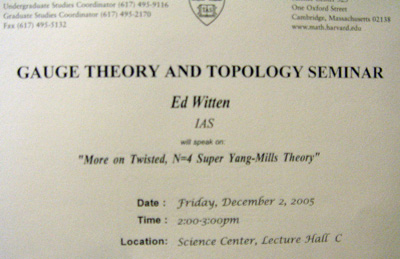
[Even string-king Ed Witten is in Cambridge! VE-RI-TAS!]
I talked to a grad student friend of Bob Hearn’s named Jacob the next day, he said the key breakthrough in most AI problems involves finding the right representation of the problem. The “aha” is all about seeing the problem in the right way. That’s kind of what hierophantics in my novel-under-revision Mathematicians in Love is all about: somehow automatically being able to immediately go to the correct computation-crushing aha representation.
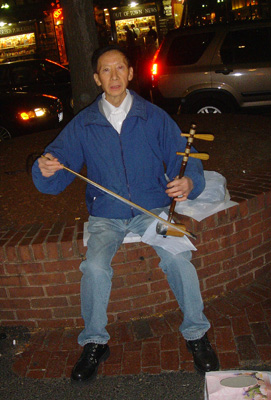
I had a somewhat discouraging book event at the MIT COOP, which isn’t even what I’d call a real bookstore; it’s more like a mall store, a concrete box with greeting cards and stationery and a handful of titles. They didn’t publicize my event, and the turnout was thin. Afterwards, full of self-pity, I felt like this poor beggar I saw playing a one-stringed violin, collecting money in an empty Kleenex box at his feet. Although, obviously, I have it much better. And, yes, I gave the guy some money.
And then I got a cell phone call from my Hollywood agent, enthused about the developments on the Master of Space and Time movie — Michel “The Eternal Sunshine of the Spotless Mind” Gondry is now working on a script with Dan “Ghost World” Clowes, and Gondry has said he plans to cast Jim Carrey and Jack Black in the film. Fingers crossed.
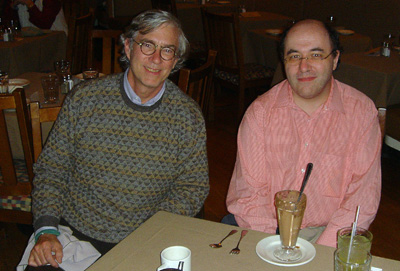
I had dinner with — back to the country-priest-in-Rome analogy — Martin Luther, that is, the iconoclastic Stephen Wolfram, a figure to be reckoned with, but not a part of the academic inner circles. We had a really enjoyable conversation.
I always think I’ve only met three or four people as smart or smarter than me. Kurt Gödel definitely is the gold standard here, the smartest man I ever met, my guru, a demigod, and to hell with those who say he was nuts, they didn’t really know him. Wolfram was the first person I met after Gödel who seemed truly smart. And later John Walker of Autodesk was the third guy like this that I’ve encountered. That’s about it. Reciprocally, Wolfram seems to find me to be someone he really likes to talk to.

My good old SF buddy Paul DiFilippo came in from Providence to visit with me the next morning. He recently wrote a very funny comic book series called TOP TEN, on the racks right now, I read the first three issues on the plane back and look forward to the closing two. Lots of eyeball kicks.
Paul and I went to look at the Science Hall instrument collection (Paul is with the original cyclotron in the photo), bascially scavenged from demo tools and lab equipment left over from earlier times at Harvard which has, after all, been in the education biz for, what, better than 200 years. The woman running the place was didactically asking us if we could see what was “wrong” with a certain mechanical orrery model of the solar system, and I told her, “We don’t know any science, we’re science fiction writers.” She found our levity in poor taste.
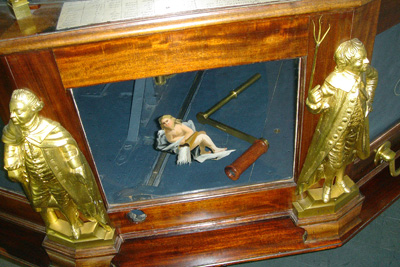
I was amused to see that in the Harvard orrery, the crank (= power lever for the cosmos) is locked away behind glass, unlike the crank at the Geneva museum of the history of science which is out there for one and all to touch. (Mentioned in the “Blog the Gnarl #3” entry of my 2004 boing boing blog.) So the spaced-out science fiction writers can’t get at it!