



Click covers for info. Copyright (C) Rudy Rucker 2021.


Archive for the ‘Rudy’s Blog’ Category

Varieties of Metanovel

Monday, March 27th, 2006

Note the two corrections to my notes on the GDC, I misspelled Pekko Koskinen’s last name, and I mistakenly said the Strange Attractors team at Ominous Development Studios were students. I’ve been playing that game by the way, it’s soothing.

After I used iTunes for a few days it broke my install of Windows XP because I *gasp* dared to take out the iPod before the sluggish and vengeful Apple-ware gave me permission, and now my machine’s at the shop getting the operating system rebuilt. [Though maybe the machine probs are unrelated to iTunes, you never really do find out these things.] Anyway I do love my iPod. I’ll write more on it later. Changing my worldview. Since I’m machine weak, I’ll just recycle old pix today.

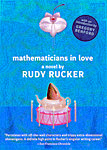
I'm wrestling with the question of what kind of novel people would write if they had postsingularity style mind amplification, helper agents, planetary ultra-wideband access for all, etc. Store it as a waking dream, as a VR, as a game? I call this a metanovel.

I’d like to get all Borgesian and Stan Lem-ish on this problem's ass. Think of a variety of oddball new ways to write a novel. (I consulted my Collected Stories by Borges already, but need to get hold of a copy of Lem’s A Perfect Vacuum (reviews of nonexistent books) for more inspiration.]

Metanovel design patterns:

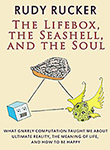
Lifebox. A metanovel that feels like a person’s whole remembered life. The art of a lifebox novel is to tweak it so that the life is a bit more interesting than your own. A lifebox novel will normally be a temporal interval of a life, possibly the whole thing. You could artificially limit yourself to hovering near the main character (third person objective) instead of inhabiting them (first person), but the third person option doesn’t make that much sense.

Inventory. This is a way of organizing a Lifebox novel. Think of Charles Simmons’s book where he goes over his experiences with various ordinary kinds of things, like a water chapter, a frying-pan chapter, a vagina chapter, a freckles chapter. hats, tongues, bicycles, dogs, trees, drugs, food, cars, clothes, teaching, voice, fish, shit, wind, kites, airplanes…. Or instead of themes, you could organize the Lifebox around locations, like by telling everything that happened in each important location in your life.

Multithread. A metanovel that’s like a movie, but with complete mental records of everyone in it. Possibly have it really be like a movie, and have the offscreen records as well. Fake a lot of the internals on a need-to-know basis, like the way you could make an infinite VR by having the landscape be created on the fly.

Forker. A metanovel that includes all N to the Nth possible options. Jorge-Luis Borges hints at this notion in his story, “The Garden of Forking Paths.”

Reverse Forker. Jorge-Luis Borges discusses this story pattern in his tale, “A Survey of the Works of Herbert Quain,” describing an (imagined) book called April March by Quain. April March begins with a somewhat ambiguous scene of a man and a woman talking, and is followed by three versions of what happened to the man and woman the day before, each of which is followed by three versions of what happened the day before that.

Mirror. A factual account of a scene followed by a metanovel version of the scene, possibly followed by a further transformed version of the scene, possibly including the metanovelist imagining the metanovel version…

Props. A metanovel from the point of view of object or objects that are passed around; one thinks, in a melodramatic vein, of a gun or a treasure. Alain Robbe-Grillet got into this zone.

Hive. A metanovel in which the “characters” are groups of people.

Animal. P.O.V. of an animal. Doesn’t need to be meta, strictly speaking, I mean look at Call of the Wild. But having the orphidnet and the possible brain access could let you really get into an animal’s p.o.v. I’d love to fly or swim.

Timeslice. An exhaustive description of everything happening in a city or a smaller zone, the description limited to one instant of time.

Reveal. A metanovel detective story that proposes the wrong solution to the crime, but with loose ends that allow the user to in fact winkle out the correct answer. This is a Borges idea. Doesn’t really need to be a metanovel, but the meta might make it possible to make this work better.

Game Developers Conference, San Jose 2006

Friday, March 24th, 2006

I got a floor pass to the Game Developers Conference in San Jose last Thursday, courtesy of my old publisher (of Infinity and the Mind) Klaus Peters, who, with his wife Alice, publishes an interesting line of math, graphics, and game-related books.

I didn’t run into anyone else I knew, and felt a bit lonely and out of the loop. Zillions of young game-biz guys there, only a few women.

Some of the ultra-geeks had balloon bee-hive hats.

Coming at games as a computer scientist, I get excited about the graphics — this is a demo of the Playstation 3, with flexing teapotaedrons.

The hardware is also very cool, like this water cooled, mirror-cased job.

But the uses these tools are put to always seem so tawdry and dull.

And playing them looks so geeky. I always find the most interesting games to be those in the Independent Games Festival. You can download a lot of these for free.

These two guys are colorful Finns, the talkative guy on the right being named Pekko Koskinen. They entered an Unreal mod called “Dragonfly Variations.” Pekko’s real passion is for three-paragraph head-games on the back of his business card. He told me that one of the greatest Finnish novels is Volter Kilpi’s Alastalon Salissa, sadly untranslated.

These fellows were competing in the Independent Games Festifal too, they had a nice single-button game called Strange Attractors. You turn the force of gravity on and off in an Asteroids-like setting, that’s all. It’s intriguing. They reminded me of the very best students I used to teach in my Game Programming course at SJSU.

Driving home, stopped at a traffic light, I saw a beautiful tree. In some oblique fashion, I'm sure that today I saw something I can use in Postsingular. I'm still wrestling with determining the nature of the metanovel…

Castle Rock Ramble, John Gardner’s “Art of Fiction”

Thursday, March 23rd, 2006

I went for a 60th birthday hike up at Castle Rock Park on Skyline Drive yesterday with Emilio, a software engineer whom I initially got to know as an occasional commenter on this blog, and who I then got to know better as a student in my Computers and Philosophy class at SJSU last fall.

It was a beautiful green day, like descending into the Hollow Earth. We worked our way down to below Castle Rock Falls and back up. And we took a lot of nice pictures. Enough about my birthday already. I’m over it.

I’m almost done reading this great little book on writing, John Gardner, The Art of Fiction: Notes on Craft for Young Writers (Written 1983, Vintage Books edition 1991). Gardner was a novelist in his own right, also famous as a creative writing teacher.

I’ve never read a whole book on writing before; I read part of Annie Lamotte’s Bird by Bird some years ago, but got tired of it: too much Annie and not enough notes on craft. Oh, I’ve looked through Strunk and White as well. (Remember I was a math major, not an English major.)

The reason I bought the Gardner book is that I’ve been thinking about point of view to use for Postsingular, my seventeenth novel. As all the characters are plugged into the orphidnet mind network, their experiences are to some extent internal, and can only be accessed by describing what’s going on in their minds. In the so-called “third-person subjective view,” you get close to a character and describe their thoughts; Gardner says the third-person subjective point of view is really the same as the first-person point of view with “I” replaced by “he” or “she”.

But I want to see into lots of people’s heads. Gardner recommends the “omniscient author” point of view, in which the author freely dips into any of the characters’ minds at any time. Think Tolstoy. Gardner says omniscient author isn’t so much used as in the past, and seems to think it’s underrated. The problem is that omniscient author can be done badly, and instead of appearing elegant, can become, rather, amateurish “wandering point of view”. Phil Dick skirts the border between the two; it doesn’t read that smoothly; maybe if he’d gone into full omniscience it would have worked better; but authorial omniscience requires, perhaps, the writer to make the psychologically difficult (for some) move of thinking of him or herself as a superior being, and this, if done badly comes across real obnox.

What I’m really going to do, probably, is something I’ve done before (as in Realware or As Above, So Below), that is to use a “rotating third-person subjective POV,” that is, to have different chapters or sections written through the eyes of different characters. And not to wander about within a single scene. To some extent, looking through a character’s head promotes them to the status of being a main character, and there’s a sense that a shapely novel shouldn’t have too many main characters.

(Another reason I’m reading Gardner’s book is because I’m mulling over what kind of style might be used for a metanovel. Maybe in a metanovel you really could have all the characters inner lives there to see. More on metanovels in a later entry.)

Even thinking about the authorial omniscient style is freeing me up in any case. I’m starting to feel free to rotate POV without always having to set the shift off with a *** line break.

The Art of Fiction really encourages me overall. I’d been a little anxious that I’d find out I’ve been doing everything wrong for the last sixteen novels. But Gardner tells it just as I feel it. And he really nails some things. And he has some very useful craft suggestions.

“Good description is symbolic not because the writer plants symbols in it but because, by working in the proper way, he forces symbols still largely mysterious to him u into his conscious mind where, little by little as his fiction progresses, he can work with them and finally understand them. To put this another way, the organized and intelligent fictional dream that will eventually fill the reader’s mind begins as a largely mysterious dream in the writer’s mind.” p. 37. And again, “…nothing in what I’m saying is more fundamental than the concept of the uninterrupted fictional dream.” p. 115.

I totally concur with that. First you see a scene as waking dream, then you write it. Actually it’s not that simple. You get a rough dream, you write it, the writing brings up new juxtapositions, symbols, and action problems, you redream it, rewrite it, and iterate. In the end, you have a dream that’s isomorphic to the text. So could you, as metanovelist, publish the thought-states of the dream instead of the text? Yes and no. Part of the pleasure of a text is flavor of the actual words, which have their own peculiar associations. So, okay, for a metanovel, you’d want the dream as a VR, but you’d want the tasty words attached.

“The fictional process is the writer’s way of thinking, a special case of the symbolic process by means of which we do all our thinking …. in some ways the elements of fiction are to a writer what numbers are to a mathematician, the main difference being that we handle fictional elements more intuitively…” p. 51.

That is so great. Painters sometimes say the canvas and oils do some of the work. Same thing with writing. The text helps you think. As I like to say, it’s a thought experiment. But you need that physical apparatus of pen and paper, typewriter or word-processor as surely as a high-energy physicist needs a particle accelerator. You need to smash the words together and see what strange particles appear in the curly trails of the spallation events.

“…the number of fictional elements that exist is finite… By the elements of fiction I mean … “event ideas”such as kidnapping of the loved one …. particles that go to make up character, such as obesity … particles that go to make up setting and atmosphere …” p. 52

Dude! Once we’re talking about recombining a finite number of elements, we’re talking about a computer program! But it needs a good seed. I think of Burroughs’s cut-up method, a crude approx. A metanovel that shuffles its elements each time you access it. Or perhaps continually, like a waterfall.

“Failure to recognize that the central character must act, not simply be acted upon, is the single most common mistake in the fiction of beginners” p. 65. I’ve been guilty of this one; in fact it still requires a conscious effort for me to get my sensitive, put-upon, misunderstood, too-good-for-this-world heroes to get out there and kick some butt.

“The amateur writes, ‘Turning, she noticed two snakes fighting in among the rocks.’ Compare: ‘She turned. In among the rocks two snakes were fighting.’ … vividness urges that almost every occurrence of such phrases as “she noticed” and “she saw” be suppressed in favor of direct presentation of the thing seen.” p. 99. Yes! Of course! I’ll start doing that. In a way this is an elementary example of using omniscient author POV instead of third-person subjective.

On transrealism: “When one writes about an actual parent, or friends, or oneself, all one’s psychological censors are locked on, so that frequently, though not always, one produces either safe but not quite true emotion or else — from the writer’s desire to tell the truth, however it may hurt — bold but distorted, fake emotion. … Real-life characters do sometimes hold their own in fiction, but only those, loved or hated, whom the writer has transformed in his or her own mind, or through the process of writing, to imaginary beings.” p. 126.

I’ve felt that, too, the liberation when a character pulls free of any realworld model I might have had in mind. As then the character can get really unpredictable and funny and deep.

Gardner also talks about rhythm in an interesting way; I’d never quite understood why I had to keep my turning sentences around until they sounded right; it’s a matter of getting a smooth pattern of stressed vs. unstressed beats (as in poetry) to create prose that would be easy and pleasant to read aloud (even though you imagine that readers are silent, the sounds of the prose are subliminally sensed.)

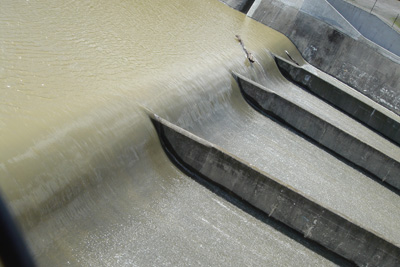
On the way home, I noticed that Lexington Reservoir is overflowing. Last time I remember that happening, Bill Clinton got elected. Like a visible I Ching sign: Overflow. Change is gonna come.

Parting shot: here’s an MPG of the Castle Rock waterfall, a 27 Meg movie of delicious natural computation. Click here to view movie. Seek the gnarl.

The Dread Day, Nathaniel Hellerstein Speaks

Wednesday, March 22nd, 2006

So now it’s finally my actual birthday and I feel good about it. I’m going for a walk in the woods.

My college friend Don sent a copy of a letter I wrote/drew for him about forty years ago.

I’ve been having fun playing with the iPod I got from Georgia and young Rudy. I have about 300 of my songs on it already. Cool to walk around inside a soundtrack. Very Postsingular.

I copied all 1,200 of my blog images so far onto it, and can slide-show them in Shuffle mode with the music also in Shuffle mode, seeing and hearing all things that I like. Lifebox!

Last night I watched a great, gnarly David Cronenberg movie, eXistenZ that I’d previously overlooked. Very inspiring. I think I’ll visit the Game Developer’s Con in San Ho tomorrow as well. Thinking about what Thuy’s gonna put in her metanovel.

Still catching up on my party, here’s a piece by my mathematical logician friend Nathaniel Hellerstein (seen in the picture below to the right, having given Nick Herbert a Hellerstein Zero Dollar Bill).

Nathaniel Hellerstein, “ADJUSTING THE DOG” (For Rudy’s 60th)

I was visiting Rudy, just hanging out at his house, playing with fractals on his computer. I had mentioned the words “fuzzy chaos”, and the “Socrates-Plato fractal”, so of course Rudy had to see it for himself. I'd shown him what I'd gotten so far, on my Texas Instruments TI-83, but of course a hand calculator's screen isn't exactly hi-rez. Rudy fired up his home station, launched one of his research programs, sat me down, showed me how to input equations and to fiddle parameters, and the next thing you know I was surfing the mathesphere.

“That one's kinda boring,” he said. “A wiggly loop?”

I said, “Let's pump up the exponent. Make it third power.” I hit ENTER and watched points accumulate on the screen.

Rudy looked over my shoulder. “Better…” he said.

” 'Seek Ye The Gnarl', ” I said, quoting him, and I went back to parameters.

We heard Sylvia yell, “Rudy!” from far away and downstairs, so Rudy excused himself. Exponent 3.1 was a bit better, but still not quite it; so I input 3.2, I hit ENTER, and I sat back.

I was still sitting there, mouth slightly agape, when Rudy returned. He said, “Sylvia wants me to adjust the dog, she says she can tell — ” Then he saw what was blossoming on the computer screen. ” — hey, that's a really gnarly fractal, Nat!”

“I wouldn't have found it without you,” I said, still stunned. And it's true; it was my equation, but his program. I had to interact with the parameters in realtime to get them just right.

Rudy said, “Listen, we have to find the olfactory remote. Sylvia can tell where Arf is, even through the wall.”

So we rummaged through Rudy's office for the olfactory remote. I found in on the bookshelf, in front of six copies of the German edition of “White Light”. It was resting between the tesseract and the flying saucer. We took it outdoors to the main porch. We knew where Arf was because we too could detect him through the wall.

Once there, Rudy boldly leaned over and patted his old buddy. Arf dog-kissed him back. I stood back at a distance of six feet. Arf was a great old dog, and I liked him a lot, but his force field really was quite overpowering. What's more, it was set on Exponential, with a doubling-distance of two feet. I wasn't ready to approach those six feet and experience that eight-fold increase in the dog's olfactory force. But Rudy didn't seem to mind.

Greetings over, Rudy stood up and fiddled with the olfactory remote. “Let's see, I'll change the field from Exponential to Step Function. What radius?”

I said, “How short can you make it?”

He said, “I can scroll it down to zero, but then you get a Dirac delta function. Let's try a foot.” He punched some more buttons on the olfactory remote, pointed it at Arf, and clicked.

Right away I felt better. I thanked Rudy, then heaved a huge sigh, which I hadn't dared to do before. The air smelled of rain, and wind, and trees, and the neighbor's flower garden.

I went over to Arf to pat him. Like I said, he was a great old dog, if you didn't mind the olfactory force field. I hugged him, and I got a dog-kiss, and whoops, I got a little too close, and worse whoops, I inhaled through my nose.

“Whuff!” I said, for words do not describe.

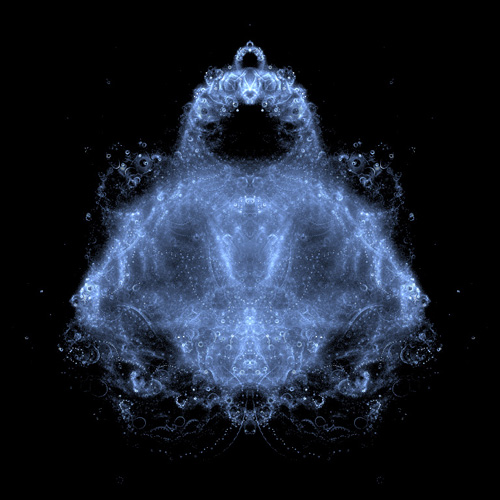
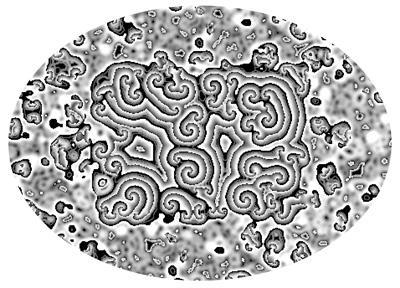
Now, you may be thinking that I made this whole story up, but it really did happen, and I can prove it, too. Just input exponent 3.2 into the Socrates-Plato fractal, and let it run awhile. You will see for yourself that it truly is gnarly. Thank you, Rudy.

(*) [(Note by Rudy.) In one chapter of his book, Delta, A Paradox Logic (World Scientific, Singapore 1997), Nathaniel imagines a fuzzy-logic world in which a statement’s truth value can be any real number 0.0 and 1.0. And he has a converstation between Plato and Socrates, with the current truth values of what they say being P and S. Plato says “I am not extremely different from Socrates,” and Socrates says “I am not even slightly different from Plato’s opposite,” meaning (in Hellerstein-speak), respectively,

P = 1 – (S – P)^E, and

D = 1 – (1 – P – S)^F.

E and F are exponents expressing, respectively, “extremely different” and “ slightly different”. As these are dual notions, we let F = 1/E. E is the exponent that Nathaniel decided, upon further experimentation, to set equal to 3.221946. Hmmm…]


Rudy's Blog is powered by WordPress