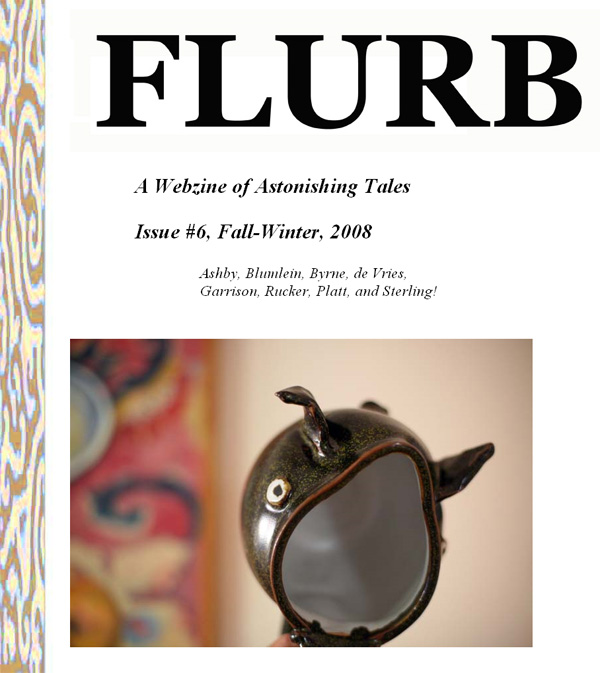




The new issue of my SF webzine, Flurb #6 , is off to a good start. We got good mentions on BoingBoing and in io9, we scored ten thousand visits in week #1, and the contributors are happy.

Sept 17, 2008.
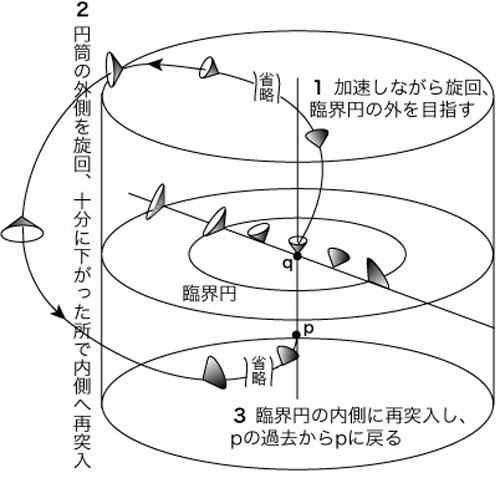
I recently read a novel, Neal Stephenson’s Anathem, in which time has a branching quality, and the characters have an ability to sniff out the best universe for them to be moving forward into. Or, put differently, they have an ability to project themselves into the more favorable regions of the Hilbert space of all possible worlds. (Stephenson uses his own made-up name—something like “Hemm space”—for this manifold of polycosmic configurations.)

Logically, I’ve always felt there to be something fundamentally incoherent (not to mention story-killing) about the SFictional notion of picking an optimal world from many equally real possible worlds.
My sense is that if time really branches, then you wholeheartedly go into each branch; you’re conscious in each of them, and there’s no single “lit-up by the searchlight of the mind” that zigzags up through the time-tree to limn the path that you “really” take. The whole tree is lit. You really and truly think you’re in each branch that something like you is in.
Restating my logical feeling in terms of the more static Hilbert space view, I’m saying that a version of my mind should be psychologically present in each of the possible worlds that contains a copy of someone like me—and that there should not be any single narrative thread of bright points marking the privileged sequence of possible worlds which I “really and truly” inhabit. The whole block is lit and equally real, and, once again, I fully feel like I’m in each possible world that contains someone like me.

Turning however from logic to emotion, I do have an appreciation and a longing for the heroic concept that I really am selecting a best possible path. I mean, that’s of how a human life is fact lived. You consider the possible outcomes of possible actions, and you direct your actions so as to realize the more favorable results.
That is, after all, one of the big evolutionary values of human-type consciousness: the ability to mentally simulate possible futures. And so we adjust our actions to enter the better worlds. As a result, we have an emotional, experiential sense that the bad, unchosen paths are in fact shriveling away to the left and the right.
But if this human sense of things reflects a real phenomenon, as novels like Anathem suggest, then we’d have to suppose that our minds somehow co-create the universe with God, helping Her/Him craft the best possible cosmic novel from the welter of possible worlds, or, putting it differently, helping the Maker carve the most beautiful universe from the Hilbert-space-quarried block of possibility-stone.
Of course an atheist will bridle at this formulation. But we don’t really need to talk about God or the Maker—we can instead talk in terms of the cosmic state function converging on some particular Attractor. But simply as a manner of speaking, it’s often easier to talk about “God”.
Setting that issue aside, there’s a more important issue to mention in connection with the notion that we might be helping the Cosmic Attractor choose the universal history. The point that I want to stress is that, although some aspects of your worldline are determined by you, some are not.
Yes, when you drive carefully and avoid having an accident, then you can say that is your personal doing, your own guiding of the world’s narrative. But when you get on an airplane and your plane happens not to crash, that’s not your doing at all—unless you want to get into superstitious, synchronistic, or magical modes of belief.
In cartoon terms, when the falling safe lands on Elmer Fudd instead of you, that’s random luck, isn’t it? Or would you instead say that you moved the universe in a good direction or that Elmer Fudd at some level wanted to die? Better to say that the Cosmic Attractor or the Divine Author felt it makes for a better overall “narrative” to have you live on instead of Elmer.
So, okay, we’re supposing that we humans help determine a unique history of the world, and I’ve just made the point that we don’t do it entirely on our own, and that some external, cosmic considerations come into play as well. But if do have some influence, we can think of ourselves as somewhat heroic.
And if this heroic view of the world is true, then we really don’t live in a multiverse, or in a Hilbert space. There really is just one true history of the world—or, not to be too strict, maybe a pruned-down skeleton of only a few possible histories, with these few forming an elegantly branching frame of a limited number of possible paths—I visualize a beautifully a silvered old bare tree on a cliff. This would be a multiverse quite different from a dense and meaningless thicket in which every goddamn possible thing happens all of the goddamn time, with every piss-ant atom’s dither of a photon-beep splitting the world yet again in two.
Just now I was having a dream about selecting particular paths through the multiverse. I was standing before a painting on an easel, or maybe even in a whole studio room of unfinished paintings, touching up scene after scene. And as I painted, I could look out into the world, and I could see the realities changing as I altered my paintings of what had gone (or would go) down.
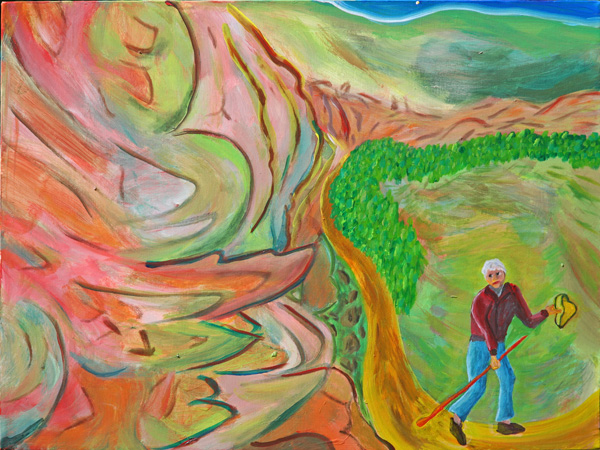
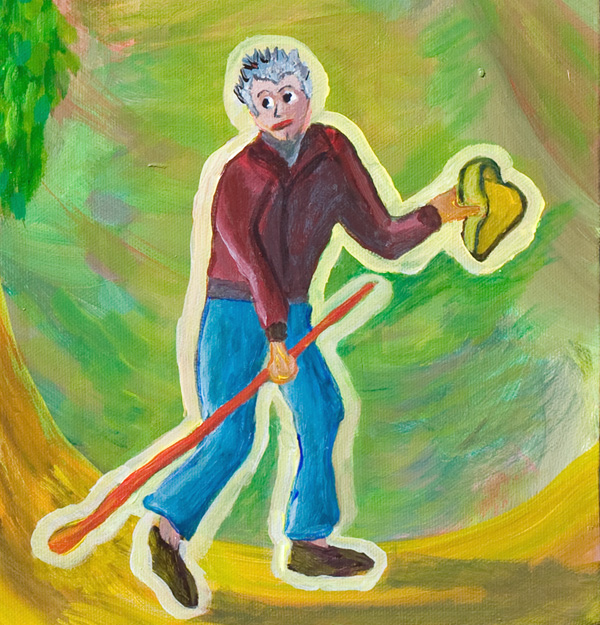
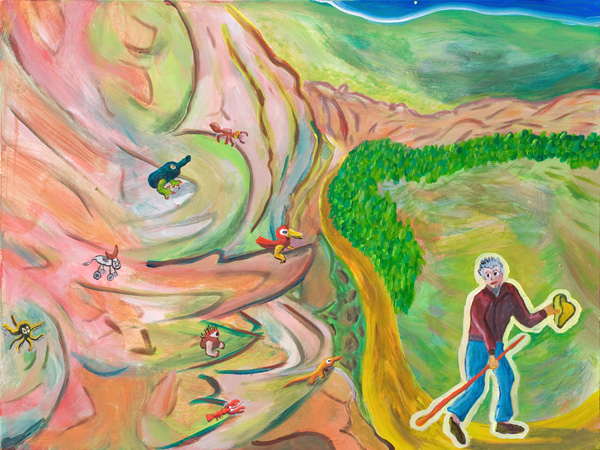
Near the end of the dream, I was working on an actual acrylic painting that is in my actual studio, that same painting called “The Wanderer,” in which the white-haired man resembling me is finding his way along a mountain path, glancing over his shoulder at his past, a cliff of odd-shaped rocks where perhaps some demonic figures lurk…and in my dream I was trying to finish the picture with the curve of the ongoing path.
And then I awoke in a sweat, came upstairs, and wrote this note, starting at 1:23 a.m. Strange.

I’ve been thinking about going to Paris to take a commission to write the libretto for an electronic-music opera about the logician Kurt Gödel—whom I had the good fortune to meet with three times in 1972—and right before going to bed tonight, I was looking through my books on Gödel, and I found one that, at least for a moment, I couldn’t remember having seen before. I had this eerie feeling that Gödel’s spirit was meddling with this branch of reality, making sure that this particular book found its way into my hand. The book turned out to be a memoir by my old Institute for Advanced Study mentor, Gaisi Takeuti, with an essay about the end about the time when Gödel was “on narcotics” and thought the true power of the continuum was alef-two. And that’s in fact how I met Gödel, he became interested in me because I’d given a talk on that odd doodle of a paper, and Takeuti told him about me. Strange.

And now, upstairs, having woken from my dream of the multiverse, it strikes me that if it really were possible to surf one’s way among the alternate worlds, then that’s exactly what I (in concert with the Cosmic Attractor) did this summer. Instead of me dying, we dodged the coffin and, against the odds, I got well.
I’m liking this branch of the multiverse, this region of Hilbert space.
Sept 19, 2008.
I finished my painting “The Wanderer” this morning. Usual reminder: you can buy prints or notecards at rudy.imagekind.com, and “The Wanderer” is on this site as well.
I got the original background by means of a trick I’ve used before: I take the left-over paint still on the palette from the last painting, thin it down, and quickly paint the shadow shapes that I see on the fresh canvas—the shadows from the trees over my back yard (my usual studio). I don’t have to think about the shapes, I’m just filling in colors in the patterns of the shadows that are actually on the canvas. I like bringing in the natural gnarl this way. And then I looked at the patterns for a few days and eventually—with my wife’s help—I started seeing it as a mountain landscape.
The critters on the rocks on the left are doodles from my subconscious, but it could be that they’re memories from the Wanderer’s past.
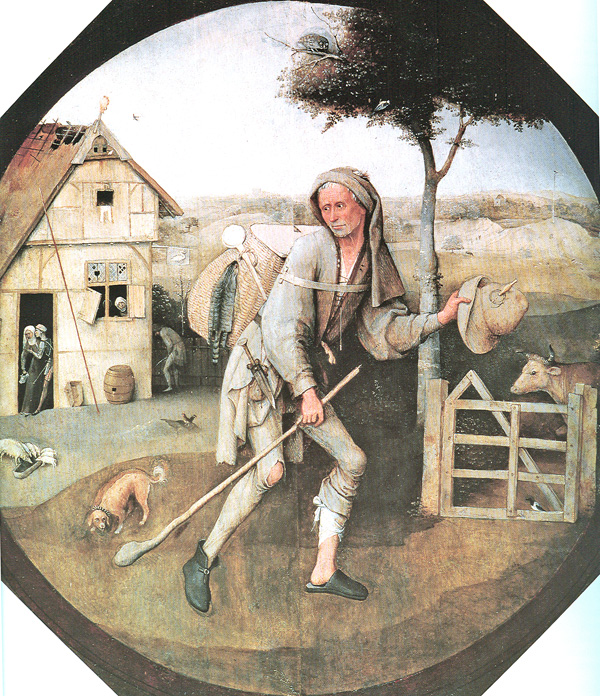
And to bring it to life, I added a Wanderer, modeled on the figure in Hieronymus Bosch’s “The Pedlar.”
I’ve always suspected “The Pedlar” to be a Bosch self-portrait, and by the same token, “The Wanderer” is my own self portrait.
“The Wanderer” represents my own life’s journey, with me currently at a somewhat confusing bend in the road, and the future entirely uncertain.